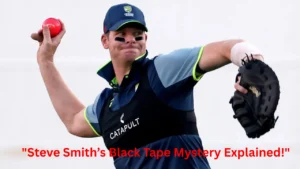


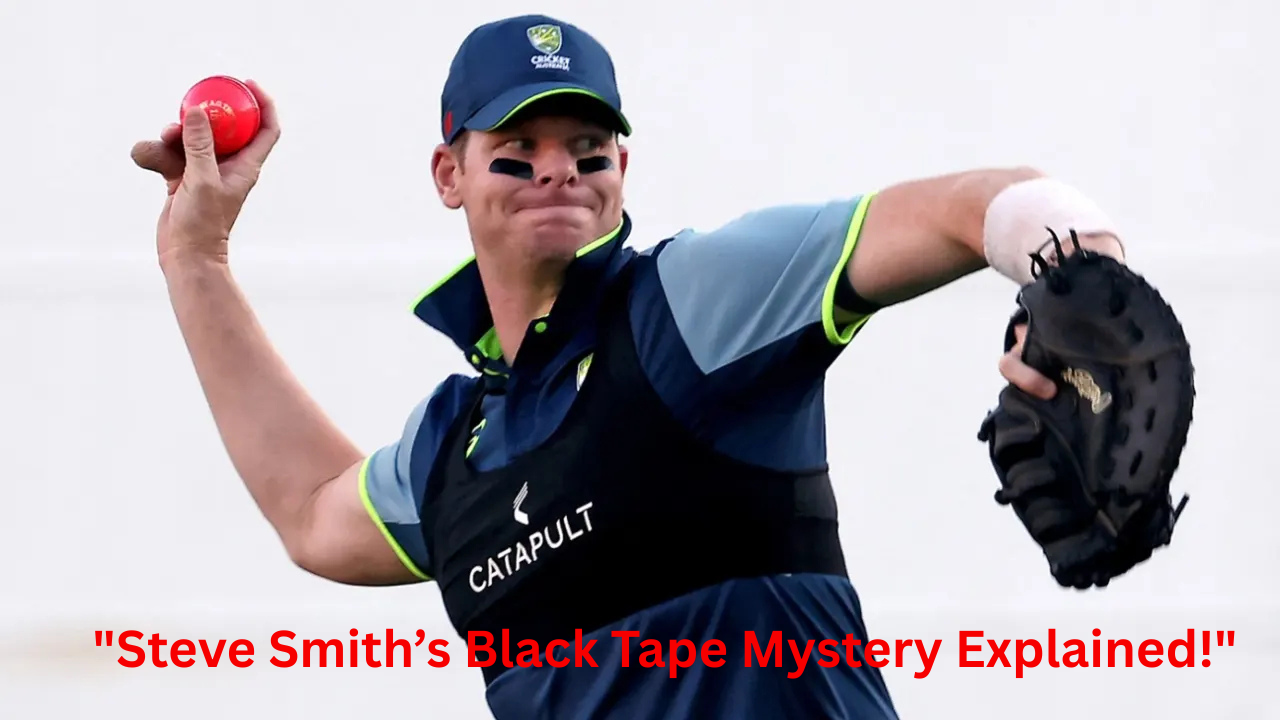
Australian star batter Steve Smith has confirmed that he will continue wearing black anti-glare strips under his eyes during the day-night Ashes Test at the Gabba. The decision comes after advice from former West Indies great Shivnarine Chanderpaul, who also used similar strips throughout his career.
Smith trained with the eye-black strips under lights before the second Test against England, and said he “definitely felt a positive impact.” Initially, though, he didn’t realise he was wearing them incorrectly.
“I actually messaged Shivnarine Chanderpaul and asked him whether he wore the chalk or the strips,” Smith said. “He said the strips, and he thinks it blocks out 65% of the glare. And he also said, ‘I’ve seen photos and you’re wearing them the wrong way.’ So yesterday I put them on the right way.”
With the correction made, Smith is fully committed:
“I agree with him. I think it certainly stops the glare. Yeah, I’ll be wearing them.”
What Are ‘Eye Blacks’ and Why Do They Matter?
The eye blacks Smith is using are common in American sports such as baseball, lacrosse and American football. Legends such as Babe Ruth and Tom Brady famously used them to reduce harsh light and increase contrast.
These small, adhesive black strips sit on the cheekbone and help absorb light instead of letting it reflect off the skin. For a day-night Test played under floodlights with a pink ball, this extra contrast can make a crucial difference — especially since the pink ball’s black seam becomes hard to pick under intense lighting.
Smith has never been a fan of batting under lights, and his numbers reflect that. In day-night Tests, he averages 37.04, while in traditional daytime Tests he averages 58.31 with 35 centuries.
Smith on the Challenges of the Pink Ball
Smith explained that batting with the pink ball can be unpredictable:
The ball behaves differently compared to the red one
Movement can change suddenly
Players must adapt in real time
“You’ve got to try and play what’s in front of you… when the ball starts doing something different, you’ve got to come up with plans to counter that, whether it be more aggressive or going into your shell.”
He added that every batter deals with these changes differently, and part of the challenge is staying one step ahead.
Gabba vs Adelaide: Why Conditions Matter
Smith referenced comments from Mitchell Starc about how the surface influences the pink ball:
Adelaide: More grass, ball stays harder for longer
Gabba: Hard, fast wicket makes the ball soften quicker
Softening can make batting easier at certain stages, so Australia will need to “weigh up” these differences heading into the match.
Flexible Batting Order for the Pink-Ball Test
With questions around Australia’s playing XI, Smith said the team is open to strategic flexibility, including using two nightwatchmen if needed.
But he doesn’t fully agree with Pat Cummins and Travis Head, who believe batting order is over-rated.
“I think it’s nice to be in a similar role and get used to that role. It can change in games, but having different spots for different innings… I’m not sure about that.”
Smith himself opened in four Tests in 2024 — including the previous pink-ball Test at the Gabba where he carried his bat for 91 not out.
Does Eye Black Really Work?
Scientific research has given mixed results:
MythBusters (2008): No major difference, unless combined with a cap
Yale University study: Found reduced glare and better contrast
University of New Hampshire study: Results insignificant due to small sample size, but noted improvements at short distances
Despite the mixed science, athletes across sports continue to use eye black because many feel a practical benefit — as Smith clearly does.
A Bigger Picture: Technology and Fair Play
Smith’s use of eye-black raises a bigger question for modern sport: how do we tell the difference between tools that simply help athletes deal with tough conditions and those that genuinely boost performance?
These small strips are an easy and safe way to fix the visual problem that the floodlights and pink ball are making. They work in the same way that supportive or safety gear is used in modern sports.. They don’t change who the athlete is; they help them perform safely and clearly in difficult conditions.