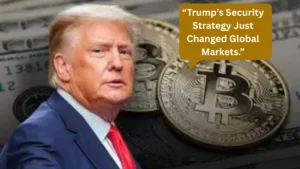



President Donald Trump’s newly announced National Security Strategy has created a wave of reactions across global markets, especially among those watching Bitcoin, gold, and U.S. bond yields. The document, which places strong emphasis on increased military readiness and global burden-sharing, reads less like a traditional diplomatic note and more like a push toward massive fiscal expansion. This shift has started raising questions about inflation, borrowing costs, and the long-term role of Bitcoin in U.S. national strategy.
A Global Push for Higher Defense Spending
The strategy calls for a major overhaul in how the U.S. and its allies allocate money for defense. NATO countries, which long operated under a 2% GDP spending guideline, are now being asked to increase that number to 5%. This is a huge jump and signals that the administration wants its partners to share more responsibility.
The Trump’s Govt has also urged Japan and South Korea to invest more heavily in defense capabilities, especially those meant to strengthen deterrence across the First Island Chain. The document further highlights Washington’s commitment to hardening its presence in the Western Pacific, while continuing firm messaging on increased defense spending with Taiwan and Australia.
All of these changes indicate that America wants its allies to contribute more and prepare for a heightened strategic environment—one that will require serious financial commitment.
Borrowing, Bond Yields, and Rising Inflation Risks
The kind of defense expansion outlined in the strategy does not come cheap. Countries that decide to follow this path will likely have to borrow more, and a surge in global borrowing often leads to an increase in bond yields. When yields rise, borrowing becomes more expensive, inflation stays firm, and interest-rate cuts lose their effectiveness.
Even though the Federal Reserve is expected to lower the benchmark rate to 3.5% next week, the benefits of this cut may not be fully felt because higher bond supply could keep yields elevated. This makes the path ahead more complicated for policymakers.
Another important piece of the strategy is the administration’s declaration that the “era of mass migration is over.” If the U.S. slows down immigration sharply, the labor supply may tighten, causing wages to remain sticky and possibly adding more upward pressure on inflation.
This environment naturally favors assets that are treated as hedges. Gold has responded strongly, rising 60% this year despite U.S. 10-year yields remaining above 4%. Bitcoin, on the other hand, is down nearly 5% year-to-date, raising questions about whether it is ready to be the “digital gold” that many hoped it would be.
The Strategic Bitcoin Reserve: A New National Asset
What makes this period even more interesting is Trump’s separate executive order establishing the Strategic Bitcoin Reserve (SBR). The reserve holds about 207,000 BTC—worth nearly $17 billion—and is funded entirely through seized assets rather than taxpayer money. Along with this, the administration has created a broader U.S. Digital Asset Stockpile, which also includes cryptocurrencies like Ethereum and Solana.
The way people in the United States think about cryptocurrency has changed a lot because of this move. The Trump government doesn’t see Bitcoin as a speculative digital good. Instead, it sees it as a critical reserve asset, like gold or energy. Previous policy proposals said that the US should hold a lot of Bitcoin as a hedge against inflation and as safety in a world where the dollar is facing more competition. This idea fits with those proposals. Similar plans are already being tried out in other countries. Russia has been getting around Western bans by using Bitcoin. Under its RESBit scheme, Brazil has given some of its international reserves to Bitcoin. Switzerland is even thinking about letting the people decide if Bitcoin should be added to its national reserves. These changes show that the world’s financial systems are slowly moving away from using the dollar, and Bitcoin is becoming an important part of this trend.
For the U.S., integrating Bitcoin into national strategy serves two purposes: it provides a layer of protection against inflation and offers a way to counter attempts by other nations to reduce reliance on the dollar. New Opportunities, Ongoing Risks, and a Changing Financial Landscape.
Bitcoin is becoming more accepted by the trump government, but it does come with some problems. Custodial security is one of the biggest worries because keeping track of such a big stock needs perfect digital security. While gold sits in vaults, Bitcoin depends on key management and secure wallets, and any mistake could lead to irreversible loss.
There is also the geopolitical factor. Countries like Russia and Belarus use Bitcoin to avoid using traditional financial channels. This gives the U.S. a digital asset that can serve both as a strategic advantage and as a weapon by adversaries. Developing long-term plans becomes more challenging when one assumes dual duties.
Despite these issues, Bitcoin’s reputation as an inflation hedge continues to expand. This is especially true as states like Pennsylvania look into plans to put some of their reserves into Bitcoin. There are reports that Bitcoin has been less volatile than stocks, which supports the idea that it is becoming a more stable economic asset.
Conclusion: A New Era of Security, Finance, and Digital Strategy
Trump’s security and crypto policies represent a major shift in how the Trump plans to navigate global inflation, national security challenges, and the evolving digital financial system. Defense spending is rising, borrowing is likely to accelerate, and inflation may stay firm. Gold is acting just the way we would expect it to in this case. Bitcoin, on the other hand, is now at a crucial point where it needs to show that it can work well as digital cash. The establishment of the Strategic Bitcoin Reserve will mark a significant milestone in history. It demonstrates that Bitcoin is not merely an asset whose value fluctuates in the marketplace; it has now become integrated into the broader strategy of the Trump government. The global landscape is transitioning toward a financial paradigm characterized by scarcity, autonomy, and strategic competition, as an increasing number of nations explore similar concepts.
Now, investors, policymakers, and markets must consider Bitcoin not solely in terms of its price fluctuations but also regarding national security, shifts in global influence, and long-term economic stability.